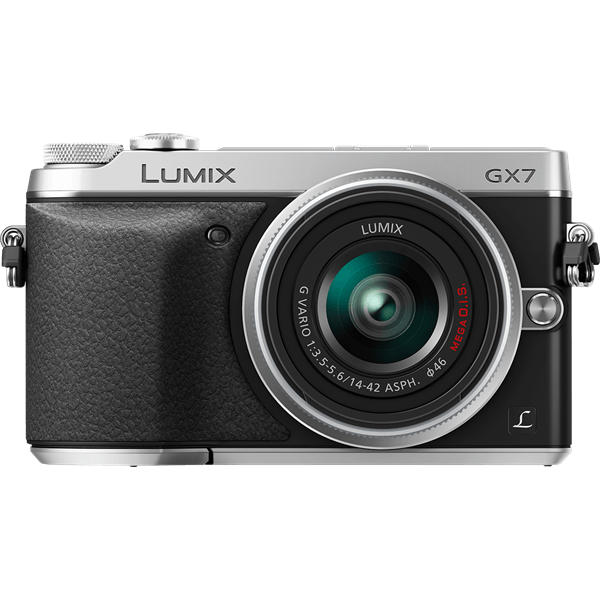
The GX7 from 2013 was a well-regarded rangefinder-style body that brought IBIS to the flat GX form factor, pairing a 16MP Live MOS sensor with 3.5-stop stabilization, a tilting touchscreen, and a 2.76MP EVF. No 4K, no weather sealing, no Dual IS. At 402g it balanced size and control layout well. It was the body that established the GX line as a serious alternative to the G and GH series, and used copies remain popular for manual-lens shooters. It replaces the Panasonic Lumix GX1. It has been succeeded by the Panasonic Lumix GX8. At 402g, this is one of the lightest M43 bodies available, 136g below the M43 average of 538g. Step up to the OM System OM-3 if you want more controls at the cost of 12g extra.
Best for: Handheld and low-light photography
Pros
- 3.5-stop IBIS for handheld stability
Cons
- Contrast-detect AF only, slower on unpredictably moving subjects
- Not weather sealed
- No 4K video
Street and everyday
The rangefinder-style body, tilting electronic viewfinder, and compact size make the GX7 a discreet street and walkaround camera. It was the first Panasonic body with in-body stabilisation, rated around 3.5 stops, which helps handheld shooting with unstabilised primes. A cult favourite on the used market for its handling and value. Full guide →
Travel
At 402g with a built-in viewfinder and IBIS, it is a capable travel camera that pairs well with small primes and pancake zooms. The 16MP sensor is dated but still produces clean files in good light, and the low used price makes it an accessible entry into a serious M43 body. Full guide →
Specifications
| Body | |
| Brand | Panasonic |
| Status | discontinued |
| Released | 2013-08 |
| Weight | 402g |
| Dimensions | 122.6 × 58.6 × 45mm |
| Weather sealed | No |
| Screen | Tilting |
| Touchscreen | Yes |
| Sensor | |
| Description | 16MP Live MOS |
| Megapixels | 16MP |
| Resolution | 4592 × 3448 |
| Viewfinder | |
| EVF | Yes |
| EVF resolution | 2.76MP |
| EVF magnification | 0.7x |
| Stabilisation | |
| IBIS | Yes |
| IBIS stops | 3.5 stops |
| Dual IS | No |
| Autofocus | |
| Phase detect | No |
| Subject recognition | No |
| Shooting | |
| Video | |
| 4K | No |
| 4K 60fps | No |
| Log | No |
| Ports & storage | |
| Card slots | 1 |
| Card type | SD UHS-I |
| HDMI | micro |
| Headphone jack | No |
| Mic port | No |
| WiFi | Yes |
| Bluetooth | No |
| Battery | DMW-BLG10 |
| Pricing | |
| Price (approx.) | N/A |
Frequently asked questions
Does the Panasonic Lumix GX7 have IBIS?
Yes. The Panasonic Lumix GX7 has in-body image stabilisation rated at 3.5 stops.
Is the Panasonic Lumix GX7 weather sealed?
No. The Panasonic Lumix GX7 does not have weather sealing. Take care in rain or dusty conditions.
Does the Panasonic Lumix GX7 shoot 4K video?
No. The Panasonic Lumix GX7 does not record 4K video.
Does the Panasonic Lumix GX7 have phase-detect autofocus?
No. The Panasonic Lumix GX7 uses contrast-detect autofocus. It is slower to lock on to moving subjects than phase-detect systems.
What card does the Panasonic Lumix GX7 use?
The Panasonic Lumix GX7 has 1 card slot and accepts SD UHS-I cards.
How much does the Panasonic Lumix GX7 weigh?
The Panasonic Lumix GX7 weighs 402g (body only, with battery and card).
Is the Panasonic Lumix GX7 still worth buying?
The Panasonic Lumix GX7 has been succeeded by the Panasonic Lumix GX8. The newer model improves on AF performance, sensor, and video specs. At a reduced second-hand price the Panasonic Lumix GX7 remains a capable body, but the Panasonic Lumix GX8 is the better long-term buy if the budget allows.